
How Latin America Became a Technology Region
Latin America is often called an emerging technology market, which undersells what already happened. In several respects the region adopted digital technology faster than the places that invented it.
Why did adoption come before infrastructure?
Because the region skipped a step. In Europe and North America, fixed lines gave way to broadband and broadband to mobile, each generation building on the one before. Across much of Latin America, mobile arrived without waiting for the fixed network to be finished.
The result is a population that is heavily mobile-first and, in many countries, more willing to adopt digital financial services than users in wealthier markets. Where a large share of the population had limited access to banking, a digital account was not a more convenient version of an existing service. It was the first version.
How much data center capacity does the region have?
Regional capacity grew from 384 MW in 2019 to 1,105 MW in 2025. For 650 million people that is modest, and its distribution matters as much as its size: almost all of it sits in São Paulo, Querétaro, Santiago and Bogotá, with Brazil alone expected to hold around a third by 2031.
Concentration has consequences. A user in Central America, the Caribbean or the northern Andes may be served from thousands of kilometres away, and that delay cannot be optimised away in software.
What is the region's quiet advantage?
Submarine connectivity. Global investment in new systems is projected to exceed 16 billion dollars between 2026 and 2029, driven largely by cloud and AI demand, with a meaningful share landing in Latin America.
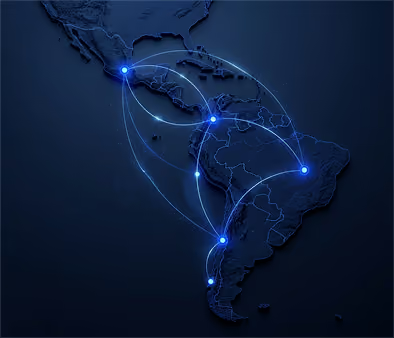
Panama occupies an unusual position as the only point in the Americas where Atlantic and Pacific systems converge. Cable geography has never mapped neatly onto economic size, which is why smaller countries sometimes matter more to the network than their populations suggest.
Why has electricity become the determining factor?
Because AI workloads consume power at densities the industry has not dealt with before, and the places best able to host them are the places with generation to spare. That is a different map from the one drawn by economic size.
Panama's energy mix reached 73 percent renewables in 2024, with installed capacity well above current demand. Costa Rica, Uruguay, Brazil and Chile all hold significant renewable positions built for reasons that had nothing to do with data centres. Markets with strong compute demand but constrained generation face the same queues now familiar in Virginia and Texas.
What comes next?
The past fifteen years were about adoption. The next phase is about location: where the compute physically sits, who has the power to host it, and whether capacity spreads beyond the handful of cities holding it today.
The region adopted the technology first. It is now building the infrastructure underneath it.
FREQUENTLY ASKED QUESTIONS
How big is the Latin America data center market?
USD 7.16 billion in 2024, projected to reach USD 14.30 billion by 2030 at 12.22 percent CAGR.
What is an internet exchange point?
A shared facility where networks interconnect directly. Without one, regional traffic often routes via the United States and back.
What are the main challenges for data center development in Latin America?
Power availability, grid reliability in some markets, and capacity concentrated in a small number of cities.
Is Latin America attracting hyperscale cloud investment?
Yes. Microsoft announced USD 2.7 billion for Brazil and USD 1.3 billion for Mexico in September 2024 to expand AI infrastructure.