From Submarine Cables to Cloud: Panama as a Digital Gateway to the Americas
Data does not move through the internet. It moves through a chain of physical assets, each owned by a different business and sitting in a different building. Cable, landing station, data centre, carrier network, platform, user. Every handoff adds delay, cost and something else that can fail.
Why does Panama sit differently in that chain?
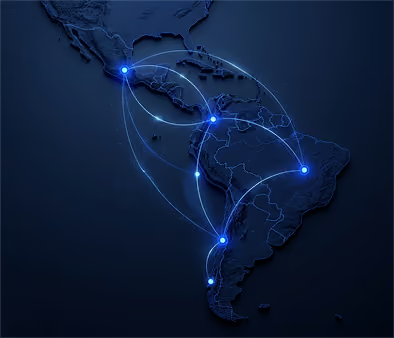
Because it is the only place in the Western Hemisphere where Atlantic and Pacific submarine cable systems converge.
Landing stations sit at María Chiquita on the Caribbean side and Corozal on the Pacific, about eighty kilometres apart across the isthmus, and seven systems currently transit Panamanian waters. The network keeps growing: TAM-1 landed in early 2026 with up to 650 Tbps, and global investment in new submarine systems is projected to exceed 16 billion dollars between 2026 and 2029.
What does carrier diversity actually mean?
That no single operator sits between the campus and the outside world, and that the separation is physical rather than contractual.
At Arrow Partners. The campus takes telecommunications entry through two separate meet-me rooms on two building entries and two physically diverse duct routes, with no fewer than three carriers and full spare capacity on every route. Diversity here is proved by physical separation rather than by circuit identifier.
Why does latency matter so much for AI workloads?
Because it accumulates. A single page load involves dozens of sequential round trips. Interactive inference is judged on how quickly the first token appears. Distributed training synchronises across thousands of nodes continuously.
Taking forty milliseconds out of a regional user base does not make an application slightly better. It changes which applications are viable at all.
The physics sets the floor. Light travels through fibre at roughly 200,000 kilometres per second, and real routes run thirty to sixty percent longer than the straight line. What a site can offer is proximity, and Cristóbal is close to the northern Andes, Central America and the Caribbean, with both oceans' cable systems reachable.
Is the network outside the building the hard part?
No. In an AI campus the internal network sets the geometry of the building itself.
The cluster network is leaf and spine, and its reach limits govern the architecture rather than the other way around: rack to leaf switch under 100 metres, leaf to spine under 500 metres, both measured along the cable route.
At Arrow Partners. The network spine sits centrally with the compute halls arranged around it, because the cable reach limits decide where a hall can physically stand. The floor plan follows the cluster, not the reverse.
What kind of occupant does a convergence site suit?
One that needs both halves of the AI workload in the same place. Training follows available power and ignores distance to users. Inference follows users, because response time depends on proximity. An operator running an integrated platform needs both, and from a single Latin American location has usually had to choose.
At Arrow Partners. Transmission-connected power at scale answers the training case. Cable convergence and regional reach answer the inference case. The campus is built for one occupant running both.
Panama does not need to win every workload. It needs to be where the traffic already passes and where the power already exists.
FREQUENTLY ASKED QUESTIONS
How many submarine cables pass through Panama?
Seven systems currently transit Panamanian waters, per the Autoridad Marítima de Panamá.
What is a submarine cable landing station?
The facility where an undersea cable comes ashore and connects to the terrestrial network, and where the submerged equipment is powered.
What is a carrier-neutral data center?
A facility where multiple network operators are present and none controls access.
What is dark fibre?
Installed fibre leased unlit, so the customer supplies its own transmission equipment and controls the capacity it carries.