Liquid Cooling in a Tropical Climate: How an AI Data Center Runs Without Refrigeration
The assumption about hot, humid places is that cooling must be expensive there: mechanical refrigeration running constantly, no free cooling, efficiency permanently compromised.
That is true of a conventional air-cooled building. It is not true of the one we are building.
Is the site actually hot?
Not by data centre standards. Design dry bulb at Cristóbal is 30.0 °C, the all-time peak across a 21-year record is 32.7 °C, and the temperature exceeds 30 °C for about 31 hours a year. Plenty of established markets run hotter.
What is unusual is the moisture. Relative humidity averages 86 percent and rises to monthly means of 90.9 percent, with a mean wet-bulb depression under two kelvin.
Why doesn't evaporative cooling work in humid climates?
Because it depends on the gap between dry-bulb and wet-bulb temperature, and here that gap is around two degrees. There is almost nothing to evaporate into.
Evaporative and adiabatic systems would consume water for a gain of a few kelvin across a few tens of hours a year, and in a chloride-laden coastal atmosphere they would work against the corrosion strategy for the whole site.
How does direct-to-chip liquid cooling solve it?
By stopping the building from making cold air at all.
A cold plate mounted directly on a processor accepts coolant at up to 45 °C and holds the chip within specification. At that temperature the building only has to move heat to something cooler than the chip, and outdoor air at 30 °C is comfortably cooler than 45.
The counter-intuitive result is that a tropical site running warm-water liquid cooling performs close to how the same design would perform in a temperate market. The climate penalises systems that need cold. It barely touches systems that only need cooler than the chip.
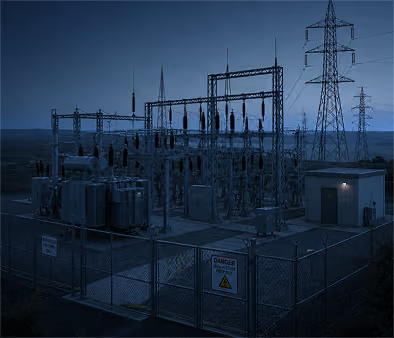
At Arrow Partners. Heat is rejected through a closed dry loop with no mechanical refrigeration stage on the liquid loop at ambient dry bulb up to 34.3 °C. Against an all-time site peak of 32.7 °C, that is free cooling every hour of the year, with margin above anything the record contains. Around 93 percent of the IT load is direct-to-chip liquid cooled.
How much water does an AI data center consume?
It depends entirely on the method. Evaporative systems lose water permanently to the atmosphere, and industry-average consumption sits near 1.8 litres per kilowatt hour of IT energy. Closed loops consume almost none, because the coolant circulates, transfers its heat and returns.
At Arrow Partners. The loops are closed and dry, so process make-up in normal operation is nil and the campus consumes no fresh water for cooling.
That carries particular weight in Panama, where the 2023 drought at Gatún Lake constrained Canal traffic for over a year and the same reservoir supplies drinking water to Panama City and Colón. A large industrial facility that places no demand on that watershed is a materially better outcome than one that places a small and carefully managed demand on it.
Is seawater cooling part of the design?
Not part of the critical design, and deliberately so. The campus is sized, placed and made redundant on the dry loop alone, so it is complete without any marine system.
Seawater heat exchange is an efficiency layer we are actively pursuing as the design develops. A coastal site gives access to a thermal sink that stays stable across the year in a way air does not, and using it would lower energy consumption further without changing the water position, since the loops stay closed either way. It is one of the reasons this location was attractive, and we are working through the maritime and environmental consents that any such scheme requires.
How is cooling kept available during maintenance?
Cooling capacity is only useful if it can be serviced without stopping the compute it serves, which means redundancy has to sit at the right level and distribution has to be genuinely separate.
At Arrow Partners. Facility water arrives at each coolant distribution unit at no more than 41 °C across a 10 K loop, supporting flow of at least 1.5 litres per minute per kilowatt. Coolant distribution runs N+1 within each deployment unit on 2N distribution, with the two facility water paths on separate routes in separate fire compartments. Every deployment unit can be isolated hydraulically and electrically on its own.
The right answer to a hot climate is not more refrigeration. It is a design that never needed cold.
FREQUENTLY ASKED QUESTIONS
Can a data center run without mechanical refrigeration in the tropics?
Yes, if the liquid runs warm. Coolant delivered at up to 45 °C means outdoor air alone rejects the heat.
What is direct-to-chip liquid cooling?
A cold plate mounted directly on the processor, carrying heat away in a sealed loop rather than through cooled air.
What is wet-bulb depression?
The gap between air temperature and wet-bulb temperature. It determines how much cooling evaporation can deliver: a wide gap makes it effective, a narrow gap makes it almost useless.
What percentage of an AI data center is liquid cooled?
At Arrow Partners, around 93 percent of the IT load.